

Showing posts with label painting. Show all posts
Showing posts with label painting. Show all posts
Tuesday, July 5, 2011
Cy Twombly Dead At 83
Cy Twombly died in Rome Tuesday, having long struggled with cancer. He was a tremendously interesting and hardworking Painter with a capital "P" from an era when that really meant something. There's a brief New York Times piece here, and a fairly comprehensive gallery/biographical site here.


Wednesday, November 3, 2010
Golub from the Block

It's strange, but artists seem to take one of two tacks when closing out their working lives. Some take solace in the spiritual, in religiosity or tribal or ethnic histories, their place in their intellectual lineage. A good example is William Blake, great anarchist poet and free thinker, who spent his final years in a sort of religious ecstasy, producing illustrations of biblical stories and Dante's inferno.
And then then there are artists who spend the last decade or so wallowing in decay and exploring their own frailty. It would be a mistake to attribute work like this to depression, it's simply a continuation of the focus and concentration with which they questioned all aspects of life beforehand. This is the fun category probably for the same reason that everyone reads the first third of The Divine Comedy and never the rest of it: suffering and unpleasantness is relate-able and universal. All happy families resemble each other-- and all that.
Artists who spend their careers casting light into unpleasant topics should owe no less to the end of their own lives. It's with this attitude that it's best to walk into the Leon Golub exhibit Leon Golub, Live & Die Like a Lion? currently at Northwestern's Block Museum, as it illuminates both the strengths and weaknesses of the work.
Gone are the large scale oil on linen canvases. The show contains one tremendously unfinished outline of a large scale work, and a few mid sized printing experiments, mostly from much earlier in Golub's career. There are themes and characters in the drawings drawn from the rest of his work, but most of the similarity ends there. The show is nearly exclusively drawings from the last five years of Golub's life, a period of prolific (if scaled) production. Most of the drawings measure about 8 by 10 inches on vellum, usually executed with oilstick and ink, with a gesture and application more spontaneous than the slow, intentional painting and scraping of his canvas works.

Also differentiating them from his other work is how solitary they are. Most of the large scale works Golub is known for are narratives of at least two characters, often a victim and (at least one) aggressor. Golub seems to have retreated from his mid career viciousness, searching for humor and ugliness in individuals, animals, and intimate acts, rather than in politically or socially motivated violence (his usual oeuvre). Satyrs fucking (it really can't be called making love) replace South American goon squads, nudes and portraits of snarling dogs take the place of apartheid regimes. It's surprising how much humor is present: goofs on Matisse and Ingres, lions, dogs, and skeletons rendered with as much (and often more) affection than his people, scrawled grafitti. Probably the best pieces in the show are the ones of couples screwing, which can't seem to make up their mind between being funny or kind of horrible, and in-between is exactly what they should be.

There are problems with the show too, some of it size. In the time period the show covers Golub produced some 400 drawings, the Block displays 42. Also (and more importantly) Golub's artistic life was a series of reactions to social events and causes, but this work feels bound inside the artist's head, and though clever and fun, subsequently feels divorced from the world he spent most of his career focused on. Without the social and moral conflicts of his large-scale paintings the work feels...well, small. The closest the show comes to real violence is still miles apart from the feeling of his earlier work. The dichotomy between spiritual and physical here certainly leans to the physical, but not with any oomph. Golub doesn't declare his belief in the beyond or the powers of harmony, far from it, but there's nothing in the show that attacks the possibility, like you see at the end of Picasso's life. There's a certain pull to the punches here that you don't see in Golub's earlier career. If at the end of his life Morandi had switched to portraiture, the result might be equally revealing, and equally frustrating.
The show is -at the very least- perfectly interesting, as are most Block Museum ventures, but it's certainly not an introduction to his work for the uninitiated. If you have familiarity with his work, or can rope someone who does into giving you a tour in the month or so the show has left, it's a must-see. Golub is an unapreciated artist, but his work is certainly going to speak to us for some time to come.
Leon Golub, Live & Die Like a Lion? runs until December 12th. You can visit the Block Museum's site here.

Tuesday, September 28, 2010
Jack Levine

Certain artists will never have a widespread public appeal. Their work is too specific, focused, obscure, referential, or just too fucking ugly to ever expose them to a wider audience. Damien Hirst and Jeff Koons produce objects and art that speak to us about celebrity, excess, exposure, and wealth, and are famous, excessively exposed, and impossibly wealthy for it. They go beyond the manufacture of art about pop culture, they live it. Even Koons's interview persona, all creepy and dead-eyed is, I maintain, an intentional homage to Paris Hilton.
There are some artists though who simply due to management, or luck, or the nature of their work can never expect their reputations known outside of art circles. Lawrence Weiner will never be Bruce Nauman (mostly because of the name), Stanley Spencer will never be Lucien Freud, etc. Jack Levine is one of these artists. He is, at 95 years old, destined to be remembered as a painter's painter.
One of the mid-century American Social Realists, Levine has spent a career lampooning power and money (the people who have them, not, like...the concepts) in pretty brutal terms. The strange thing about his obscurity, versus someone like Koons, is that Levine's message seems so appropriate to today's audience. Koons creates work that we interact with the same way we interact with MTV Cribs or the Jersey Shore; it's designed to be envied, derided, laughed at, to offend or excite, but to do it out of reach. This is work made by, purchased, and displayed by the implausibly wealthy, as we sit on couches and critique, imagining we have a role in the process. Levine, meanwhile, deals in an explicitly middle class outlook, less glitzy, more clever, angry, and translatable than a lot of the gentle intellectual abstraction you can see today.
 Jack Levine was born January 3rd 1915 in Boston, to a tight-knit lower middle class Jewish family in the South End. From a young age he displayed an affinity for drawing and, at fifteen, he and Hyman Bloom began an apprenticeship of sorts with Harold K. Zimmerman, who was then teaching at the West End Settlement House. In the early 1930's the two fell under the sway of Denman Ross, who was then the force behind Harvard University's art department. Both later credited Zimmerman's instruction in drawing and Ross's very particular color theories (full Google book here), although Levine said neither ever adopted them fully.
 |  |
A stipend from Ross had allowed Levine to concentrate on his studies. After Ross suspended it Levine found himself without a job or income at the height of the Great Depression. After working for the Works Progress Association on and off for four years he was found ineligible for further work there and enlisted in the army in 1942. His poor childhood, years of unemployment and underemployment, and his time in the stifling atmosphere of the army all marked in him a dislike of economic and authoritarian hypocrisy. After his discharge in 1945 he embarked on four decades of artistic production and biting social commentary.
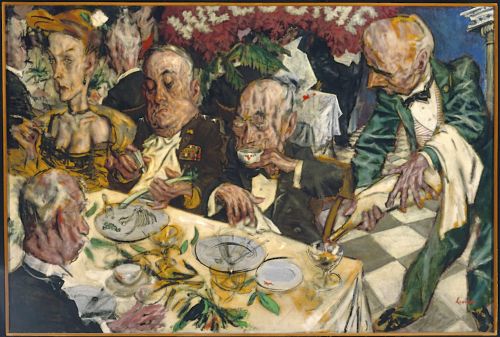
Welcome Home (above), which he painted after leaving the army, caused a furor when it was shipped to Moscow a few years later as part of a traveling exhibition.
Eisenhower, when asked by a reporter about it answered "[It] looks like a lampoon more than art, as far as I’m concerned."
Seen in the context of the artists/editorialists who proceeded him it becomes clear that Levine's hand is tied to his content. There's certainly a shared aesthetic to the body of work on the line between Social Realism and Expressionism. You see a shared subjective eye in Goya, Daumier, Lautrec, Philip Evergood, George Bellows, Leon Golub, Nancy Spero, Ben Shahn, Ivan Albright, and others. The energies that other movements have invested in harmony, balance, or color these artists have turned towards describing dissonance, violence, hate, and fear. Using a visual medium -rather than a spoken or written one- to describe something or someone you hate is a visceral experience, and these artists have taken full advantage of it. Levine's paintings sometimes seem as if even the paint abhors describing its subjects. Strangely, he rejected the Wiemar Expressionism which his work is often compared with. For him the distortions were too much; he felt the Germans sacrificed a level of objectivity he seemed to regard his own work with.
 |  |
 |  |

In all Levine is one of the talented American draftsmen of the last century. The movement towards abstraction paused just long enough (after the start of the Great Depression and up until the early 1950's) to allow him and other socially conscious painters like him to flourish. However, the rapid change in American art during the later half of the twentieth century was not amenable to figuration, and not to Levine. Like many other artists and many traditional techniques he was lost in the shuffle.
However, with the (comparative) re acceptance of figuration, the greatest economic recession in a century and the wealth disparity in the country growing further and further it seems to me that Levine is due for a comeback. Looking at his work now it occurs to me how little has changed in terms of wealth distribution in the country since it was painted. I'm no fan of populism (mostly because it's so often misdirected, I mean, come on guys, Jews are not at fault for this stuff) but these days anger at the richest 1% of Americans strikes me as healthy. Levine's work (at least one example) can be found in museums in most American cities, and because so many of us are unemployed now there's plenty of time to look at them. We don't have a new WPA yet, but it's never too early to start get organized and get outraged.

all images are Levine's unless otherwise noted
Subscribe to:
Posts (Atom)