Showing posts with label rant. Show all posts

Friday, October 7, 2011

Now This Is A Crazy Person Blog Rant..

Watching Nova | Building the Great Cathedrals and boy, is it both interesting and horrifying. There is an excellent documentary here, really, the visuals alone should be unimpeachable: high def video tours of some of the most impressive gothic structures? A huge compilation of medieval scrollery? Shit son, slap a Ken Burns After Effects filter on that shit and call it a day. And yet this is unwatchable, an unfocused mishmash of the worst Discovery channel 'What Did Judas Iscariot Really Sound Like?' lowest common denominator-y and the DaVinci Code knockoff effects that are so popular in today's history docs.
Is this really how we understand the past now? Does our narrative of the past really require conspiracy theories and Tom Hanks looking like a sexually predatory freshman year literature professor? All the evidence would seem to endorse the conclusion, which is strange, because the last three or four years have been great for documentary filmaking. Actually the kinds of documentaries that the academy has been recognizing as of late (meaning, like, since The Fog of War in 2004 if memory serves) are contemporary issue docs; why public school voucher programs work, our country's health care system is broken, the bank bailout was engineered to increase bank profits and fuck everyone else, public school voucher programs are the devil, etc.
History documentaries, their subjects further from our collective immediate experience, their talking heads all academic rather than the worn yet fierce visages of the aged fighters of wherever, their audience more couchridden than politically engaged, have felt the tidal wave of popular demand for Dan Brown stronger than most.
"But what's the problem with there being unnecessary and frankly retarded stylistic flourishes in contemporary history documentaries?" I hear you, the non-existant reader, cry, "At least people are learning something about how, like, people went to the bathroom in biblical times or whatever." True, dear nonexistant reader, knowledge is good, really any amount will do, but here the formatting itself undermines that greater purpose. By appearing so similar to The DaVinci code or The Secret these documentaries lend a certain, I don't know, a 'credence by visual effect proxy'. You can't suggest that in aping the visual effects of these movies these projects are not trying to --in effect-- borrow against the 'reality' of these movies and trade on the audience's relationship to them. Using narrative fiction to illuminate reality is not the worst thing, and there are presumably good reasons to do it. For example high schoolers with less-than-entirely formed senses of history probably learn more from the emotional melodrama of Tale of Two Cities than from a survey course of late 18th century French culture. What's dangerous is the sense of using fiction as a context for historical fact rather than the other way around. "Historical" documentaries like this feed and endorse a culture of paranoia acceptance; seeing Did The Dead Sea Scrolls Predict The End of Days? every other day on the History channel normalizes something like Loose Change after a couple of years, both endorse paranoiac ramblings, disingenuous editing, and shithouse-crazy fringe conspiricists, and if one of them is still good enough to air on the History Channel...

Friday, November 5, 2010

Things Are Looking Up For Ol' Liz Lemon

Is it wierd that my nickname for myself is Liz Lemon?

Things actually have gone well today, I'm maybe writing for Chicagoist now (upcoming week is tryouts or probationary period or whatever), which is great.
Also going to SOFA/Inuit/Outsider Art Show at Navy Pier tomorrow, which should be fun in a Hunter S. Thompson gonzo kinda way: I'm attending with a huge amout of mescaline and crack cocaine, looking to give my first submitted piece a sort of subjective, public-disturbancy oomph.
Really should be fun.

Also, have decided to start drawing/posting one page a day of a comic I've wanted to do for a long time. Won't be very tightly plotted, but that's not the point. Anyway, first page today.


My apologies to Borges (you can read his short story 'Ragnarok' here).

Tuesday, September 28, 2010

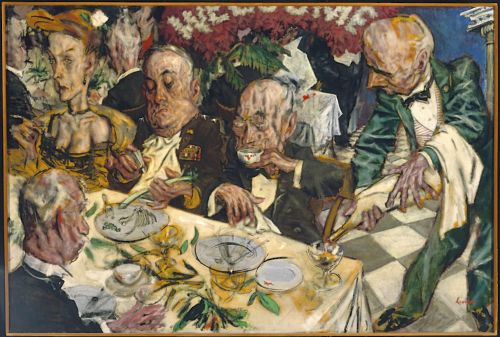
Jack Levine


Certain artists will never have a widespread public appeal. Their work is too specific, focused, obscure, referential, or just too fucking ugly to ever expose them to a wider audience. Damien Hirst and Jeff Koons produce objects and art that speak to us about celebrity, excess, exposure, and wealth, and are famous, excessively exposed, and impossibly wealthy for it. They go beyond the manufacture of art about pop culture, they live it. Even Koons's interview persona, all creepy and dead-eyed is, I maintain, an intentional homage to Paris Hilton.

There are some artists though who simply due to management, or luck, or the nature of their work can never expect their reputations known outside of art circles. Lawrence Weiner will never be Bruce Nauman (mostly because of the name), Stanley Spencer will never be Lucien Freud, etc. Jack Levine is one of these artists. He is, at 95 years old, destined to be remembered as a painter's painter.

One of the mid-century American Social Realists, Levine has spent a career lampooning power and money (the people who have them, not, like...the concepts) in pretty brutal terms. The strange thing about his obscurity, versus someone like Koons, is that Levine's message seems so appropriate to today's audience. Koons creates work that we interact with the same way we interact with MTV Cribs or the Jersey Shore; it's designed to be envied, derided, laughed at, to offend or excite, but to do it out of reach. This is work made by, purchased, and displayed by the implausibly wealthy, as we sit on couches and critique, imagining we have a role in the process. Levine, meanwhile, deals in an explicitly middle class outlook, less glitzy, more clever, angry, and translatable than a lot of the gentle intellectual abstraction you can see today.

Jack Levine was born January 3rd 1915 in Boston, to a tight-knit lower middle class Jewish family in the South End. From a young age he displayed an affinity for drawing and, at fifteen, he and Hyman Bloom began an apprenticeship of sorts with Harold K. Zimmerman, who was then teaching at the West End Settlement House. In the early 1930's the two fell under the sway of Denman Ross, who was then the force behind Harvard University's art department. Both later credited Zimmerman's instruction in drawing and Ross's very particular color theories (full Google book here), although Levine said neither ever adopted them fully.


Denman Ross left, and Hyman Bloom, right

A stipend from Ross had allowed Levine to concentrate on his studies. After Ross suspended it Levine found himself without a job or income at the height of the Great Depression. After working for the Works Progress Association on and off for four years he was found ineligible for further work there and enlisted in the army in 1942. His poor childhood, years of unemployment and underemployment, and his time in the stifling atmosphere of the army all marked in him a dislike of economic and authoritarian hypocrisy. After his discharge in 1945 he embarked on four decades of artistic production and biting social commentary.


Welcome Home
(above), which he painted after leaving the army, caused a furor when it was shipped to Moscow a few years later as part of a traveling exhibition.
Eisenhower, when asked by a reporter about it answered "[It] looks like a lampoon more than art, as far as I’m concerned."

Seen in the context of the artists/editorialists who proceeded him it becomes clear that Levine's hand is tied to his content. There's certainly a shared aesthetic to the body of work on the line between Social Realism and Expressionism. You see a shared subjective eye in Goya, Daumier, Lautrec, Philip Evergood, George Bellows, Leon Golub, Nancy Spero, Ben Shahn, Ivan Albright, and others. The energies that other movements have invested in harmony, balance, or color these artists have turned towards describing dissonance, violence, hate, and fear. Using a visual medium -rather than a spoken or written one- to describe something or someone you hate is a visceral experience, and these artists have taken full advantage of it. Levine's paintings sometimes seem as if even the paint abhors describing its subjects. Strangely, he rejected the Wiemar Expressionism which his work is often compared with. For him the distortions were too much; he felt the Germans sacrificed a level of objectivity he seemed to regard his own work with.


Above:Ivan Albright, left, and Leon Golub, right. Below: Levine.


Of course, to describe Levine's work as being as fatalistic as Albright's would be a mistake. Levine, like Hyman Bloom, had a weakness for retelling Biblical stories. Especially after his father's death (in '39) there is a streak of reverence in his work. Jewish patriarchs, bible stories, virginal characters are all safe from Levine's tendencies as a satirist. Even the bodies in these works are different, blocky and clumsy, like children's drawings. The jowliness, the puffy fat contrasted with spindly thin features, the empty, drawn smiles of his other work disappears in these, replaced with a broadness, a sort of Semitic rough-hewn beauty. In his patriarchs we see confident, reserved men of learning, in his biblical figures we see farmers. But although well painted, and a shock to what devotional art can look like, these works are missing the edge that sets his "observed" pieces apart (although he can come close, see below). It's the decadent urban, not the reserved pastoral that Levine is rightly (relatively) famous for.


In all Levine is one of the talented American draftsmen of the last century. The movement towards abstraction paused just long enough (after the start of the Great Depression and up until the early 1950's) to allow him and other socially conscious painters like him to flourish. However, the rapid change in American art during the later half of the twentieth century was not amenable to figuration, and not to Levine. Like many other artists and many traditional techniques he was lost in the shuffle.

However, with the (comparative) re acceptance of figuration, the greatest economic recession in a century and the wealth disparity in the country growing further and further it seems to me that Levine is due for a comeback. Looking at his work now it occurs to me how little has changed in terms of wealth distribution in the country since it was painted. I'm no fan of populism (mostly because it's so often misdirected, I mean, come on guys, Jews are not at fault for this stuff) but these days anger at the richest 1% of Americans strikes me as healthy. Levine's work (at least one example) can be found in museums in most American cities, and because so many of us are unemployed now there's plenty of time to look at them. We don't have a new WPA yet, but it's never too early to start get organized and get outraged.


all images are Levine's unless otherwise noted

Sunday, September 26, 2010

Google Birthday/Immortality Cake


Wayne Thiebaud wishes Google a happy birthday today! They're 12 and one of the largest online forces in the world! He's 89! And alive!

Being alive at that age should be celebrated even if you're not one of the greatest of the Bay Area artists. That is a ridiculous number for a painter to live to. Galapagos Tortoises maybe, but they don't work around turpentine, now do they?


Google should be running a special 'Holy Shit Wayne Thiebaud isn't Dead' graphic, starting now and running until Thiebaud dies at the ripe old age of a bazillion.


Ok, I should just admit that all I want to do is look at Thiebaud's paintings.

In other news: the painter Jack Levine is 95 and still kicking.

More on that tomorrow, he's a cool guy and not enough people know him. Should write that shit up straightaway, but verytired.

Monday, September 13, 2010

Fuck Dune

Last night I watched Dune. The 1984 David Lynch one. Actually, watched might not be the right term, this is more a movie that inflicts itself on you.


It's unbelievable what a trainwreck it is. Nathan Rabin has a great writup over at The AV Club which is the perfect analysis of this film's fuck-ups. I did, however, want to add one thought. This movie clearly got away from everyone involved. Lynch isn't always the best straight-narrative film-maker (I can't really picture what about Eraserhead or The Elephant Man would convince people he should make this movie) but he's got a great flair for atmosphere and visuals; which makes the movie's lack of both especially depressing. There are a few striking images, the 80's washed-out look of Fremen standing semi-circle in the desert or the cutaways to Paul's unborn sister in the womb come to mind, but not too much more. Also, this is the only movie I've ever seen with clumsily handled exposition in literally every line. But my bigger complaint is actually about the actors.
This movie has an all-star cast, and by that I don't mean Shia LaBeuof, Megan Fox, Guy-from-James-Caan-Vegas-show, and both John Turturro and Jon Voight needing boat-payment-money, I mean a real all-star cast. It's jam-packed full of awesome character actors who are all the best parts of other movies. The problem is none of them seem to realize what the movie they're in is going to look like. For some this is a fun scream-fest chance to get really nuts: Sian Phillips, Brad Dourif, Sting, Kenneth McMillan, and Jack Nance fall into this category. Others, Jurgen Prochnow, Kyle MacLachlan, Jose Ferrer and Francesca Annis spend the entire movie looking over-serious and whispering very quietly. It's as if Lynch treated the actors like they were all making different movies, and for these five it was some kind of silent pictures-era Lifetime movie. Others are just totally lost looking or their talent is wasted. It's kind of surprising it's not a film written, directed, produced by, and entirely starring Alan Smithee's.

Fuck Dune.

I'm gonna give the 2000 TV movie a try next week.

Still....Fuck Dune.

Friday, August 27, 2010

Playtime at Rotofugi


Whew. Tonight I was at a party for the opening not only of Chicago gallery/toy store/awesomeness repository Rotofugi's new location, but also the current show there: Playboy Redux. The show, which is in honor of Playboy's 50th anniversary, was orchestrated by Playboy Enterprises and the Warhol Museum, where it showed before coming to Chicago.

From Rotofugi's site:

Known at that time for her satin bunny suit, cotton tail and rabbit ears, the Playboy Bunny served cocktails and glamour in equal doses. Many luminaries once worked as Bunnies, including Deborah Harry, Gloria Steinem and Lauren Hutton. For Playboy Redux: Contemporary Artists Interpret the Iconic Playboy Bunny, artists were asked to create a new look for the Bunny, a veritable makeover to create the Bunny of the future.


So, first things first. Rotofugi's new location is amazing. It looks like social deviant art monkeys took over a nice Apple store and had their way with it. The size alone, compared to the cramped one-bedroom apartment style store they previously occupied on Chicago and Damen, blows you away. Add to that the fact that their gallery space is now integrated into the store environment and it makes for a perfect statement on the fusion of old-fashioned fine art, like painting and photography, and um...new fashioned fine art, like graphic work, illustration, and DIY designable maquettes.

Now then, the show. It's pretty apparent that Playboy Enterprises had a hand in it, as this is not a collection of work you'd expect to see in an independent exhibition. The art doesn't really ask anything about the mid-century Playboy mentality, it's just fond reminiscing in the service of the Playboy look. This is the problem with a corporation/brand having a say in the curation of an art show about that brand's iconography and legacy, especially if those happen to be a controversial as Playboy's. I don't mean that the Playboy of today is controversial, it isn't. But the Playboy of the Playboy Clubs era--the period that inspired the show--that inheritance is probably still fair game for debate.

The press release quoted above notes that the list of bunny graduates include Gloria Steinem, which seems like somebody's little in-joke more than anything else. Steinem worked as a bunny in the New York club in 1963 as research for her article "I was a Playboy Bunny"... you can guess what she had to say about the experience. The Playboy Clubs were at best harmless and offensive, and more often misogynistic, patriarchal, and declassé. Obviously it's easy to forget about this, the casual disregard for women the clubs evidenced has been hopefully drowned by progress and is hard to recall, and artistically the colorful, retro, swingin' vibe that we associate with the time period helps to assuage what it's values really were. That's the real issue i take with the show's content, it's harmless fun jaunty work (most of it anyway), more pastiche of the period's aesthetics than content or commentary. It's a show that watches Mad Men and then says to you, "Wow, everybody back then really knew how to dress!"

There are exceptions. Some of the artists have taken the Playboy label and twisted it in unexpected ways, some of which reflect on Playboy and some on their own work. Rod Filbrandt's small goauche and ink drawing is so mindlessly energetic and positive that I can't help but think he's in on the joke. Isabel Samaras and Ain Cocke also deliver great pieces, neither of which ape the mid century Jetsons look, opting for the sort of paintings you could imagine Playboy purchasing for the offices, self aware cheesecake that looks more period but is also more self aware than most of the other works. Cocke's especially is an awesome gag that's made better by thinking only you and the painting are in on it. Brendan Fernandes's piece "Bunny Dearest" is probably the loneliest art in the exhibition. While everyone else indulges in pastel color and swirling pattern Fernandes's piece is all stark sparse black lines that are an incredibly refreshing break.

Tim Biskup has what is easily the most confrontational work in the show. While everyone else has chosen coquettish/sexy or graphic/grotesque, Biskup's is the only bunny that looks contemporary, self assured, and straight up pissed. This painting would be fine with leaving the club, locking the doors from the outside, and burning it down. Also, nestled in the back corner of the gallery is a Travis Lampe painting "Bump Mate" that quite simply represents what I think this show could have and should have been: titillating fun, and also gross and unsexy.


Lampe (left) and Biskup's (right) work

All in all it's worth seeing, if only for those few works and to remind yourself that art has a purpose. Allowing an opportunity to examine the meaning of a symbol like the Playboy Bunny to escape unscathed is a tremendous failing, and the show lacks a depth because of it. Still, Hef will have to kick it one of these days, smothered under a blanket of nubile (but disgusted) young flesh, and think of the show we'll have to look forward to then.

You can see all the work in the show here, but just nut up and see it in person.

The show runs through September 12th. Rotofugi is located at 2780 N Lincoln Avenue.

Thursday, August 26, 2010

West Prize 2011 is underway


Above is 2010 West Prize winner Ryan Mclennan's piece 'Departure'

Wowzers.

The West Collection is an art collection privately owned and administrated by Alfred P. West and his daughter Paige West. Recently in an effort to expand museum holdings/garner new talent/subsidize poor-creative-types the collection is holding an open call for new artists. The competition will award 10 artists (in acquisition funds for work) $10,000 each, with one grant winner also receiving $25,000 for a proposal probably presented via one kick-ass powerpoint presentation. This competition is, at two years running, incredibly new.

Actually in a way it is and it isn't.

Right off the bat, rich people collecting art isn't exactly new. Thank god it isn't, the wealthy have been and continue to be awesome lifelines for a lot of great artists who would otherwise be selling their bodies to get money to buy pencils (crack pencils). However, in an art environment with less and less significance attributed to "critical authority" it's the market that determines artistic merit. Meaning rich curators have the hugest say right now in determining what is "good art" and subsequently what art gets funded/seen. That means if moneyed collectors don't know what they're doing they can consecrate crap, shit-up the careers of promising artists, and destabilize market value. That's how it's not new.

Alfred (Al) West, founder and CEO of SEI Investment Co. is a self made billionaire. Billionaire. Daughter Paige is a full time art curator and author, with both studio and arts administration training, and apparently really is the force behind the collection. Meaning no disinterested-commodities-broker-hiring-art-buyers-to-diversify-their-investment-holdings-with-art type situation. Also, they stock their investment company's offices with artwork, and force the employees to deal with it/suck it. These are exactly the kind of rich, informed, engaged fucking lunatics you want at the helm of something like this. That's how it is new.

I'm not particularly nuts for all of the work that the Wests seem to be focused on, a lot of the 2-D work especially, which seems to be acutely aware of the amount of Whimsy and Idiosyncrasy that Contemporary Art has to have. This may just be a feature of the current self-fulfilling market for those sort of pieces. The sculpture, video, photography, and installation seem more on-point. The Art Blog has a great write-up of last years competition, they are as usual, spot on.

That having been said there's also clearly a point of view to the collection, they obviously know what they want. There's a lot of emphasis on the environment, of consumption (conspicuous and otherwise), on nature vs. city living, etc. Having perused the current entries I encourage all artists and artistically minded crazy people to apply. The rolls close Novermber 1st, 2010, and finalists are announced January 1st, 2011.

Enter the competition here

So tailor your work and get to it! Crazy prize money and glory await!


Tuesday, August 24, 2010

I just hope this shit works

According to conservative estimates I enjoy making up, there are an estimated 133,000,000 blogs currently online. Out of those 133,000,000 how many are updated regularly? Blog inactivity stands at about 66% (or did, according to some slightly older figures). Which means more than a significant few of those millions are languishing in blog hell, stranded in 2002, never updating, still displaying observations about how the upcoming invasion of Iraq is, "like, so totally bullshit."

I speak from experience about this, as I spent my college years abortively starting and subsequently abandoning art blogs. It's an easy problem to fall into. You start off well enough, everyday uploading a new photograph of a different Japanese tea set, or a painting of a banana, or if you went to art school, the words "banana" or "tea set" hand drawn on heavy wove cream paper in an approximation of Helvetica. But soon you miss a day, or two, or three, or you wake up one day and realize that somewhere out there still exists a blog you started six months ago and haven't updated in five. And at that point your tour of blog hell begins. You can't bring yourself to go back to contributing, ignoring the conspicuous near half a year gap in your posts, but you also can't bring yourself to put the poor animal out of its misery, shivering doe eyed thing that it is.
Telling yourself that you owe it to yourself and, and damnit, you owe it to the blog, you weakly carry on with a few self deprecating posts about your lateness, convinced that the dedicated few pulling for Bobspot.blogspot to get back on track watch with baited breath. Of course unless your weblog specializes in niche pornography this hope is almost certainly in vain. And so, one day, ashamed, bitter, tired, old, your dreams turned to sludge like a clichéd metaphor in a Mickey Spillane novel, hunched over a computer you once shared so many hopes and dreams with, you sever your online connection with the world of men, and retire to a small town where you get a job as a line chef and think wistfully on what might have been.

The truth is it is hard to maintain faith in an endeavor like that if you don't think anyone's watching, which is probably a rapidly aging concept in the internet age. That we are increasingly a world of digital hobbyists means our web personas are becoming the more effective way not just to communicate but to contribute to culture in meaningful ways. In five years (less probably, I just don't want to undershoot) the idea of abandoning a twitter feed or tumblr page will be akin to packing up everything and moving to Alberta without telling anyone, in that it'll be considered rude and only assholes trying to make statements will do it. So in a way, we are living in the last foreseeable golden age of avatar irresponsibility. It is still possible to ignore your social media obligations, because for all the bullshit about social media and p2p marketing in the internet age, these things are not social media obligations, not quite yet.

And so, in the likely case that this effort goes the way of the 66%, or that I find I can't stick with preaching to an audience that occasionally reaches skyward towards the single digits, I would like you (the internet) to know, that if it ever comes to it, an' my blog's real sick, then I'll be the one to take 'em out behind the barn, on accountin' I can't stand to see it suffer.

Why is this the introduction to a blog where I plan on posting cartoons of people I see on the bus picking their noses? Well, I do occasionally find nerd theory interesting, and besides, I think that personality on the web should be fun to work with, and acknowledging the type of relationship you expect (or hope) to have with a medium should really be your first step in exploring it. Also, I suppose I realized I was going to need to square my relationship with my digital past before trying blogs again.

And this seemed a better option than burying my last blog in the ol' pet cemetery over yonder.

Because sometimes dead is better.